At Clean Oil Services Pty Ltd, our oil analysis testing program provides valuable information that supports preventive maintenance planning, improves lubrication management and helps businesses reduce operating costs.
Why Oil Analysis Matters
Used oil analysis provides a wide range of operational and maintenance benefits for industrial machinery, hydraulic systems, engines, gearboxes and heavy equipment. Benefits of regular oil analysis tests include:
- Monitoring contamination entering machinery
- Measuring equipment wear rates accurately
- Identify premature wear early
- Detecting contamination problems before failure occurs
- Improving operating practices to achieve lower wear rates and cleaner systems
- Monitoring lubricant condition and remaining oil life
- Improving oil performance and extending drain intervals
- Verifying the correct oil grade is being used
- Reducing downtime and unplanned breakdowns
- Supporting preventive maintenance planning
- Identify best practices for improving machine health and operating efficiency
A consistent oil analysis program allows businesses to make informed maintenance decisions based on actual equipment condition rather than relying solely on scheduled servicing. Oil analysis testing helps businesses maximise the value of both their lubricants and machinery assets.
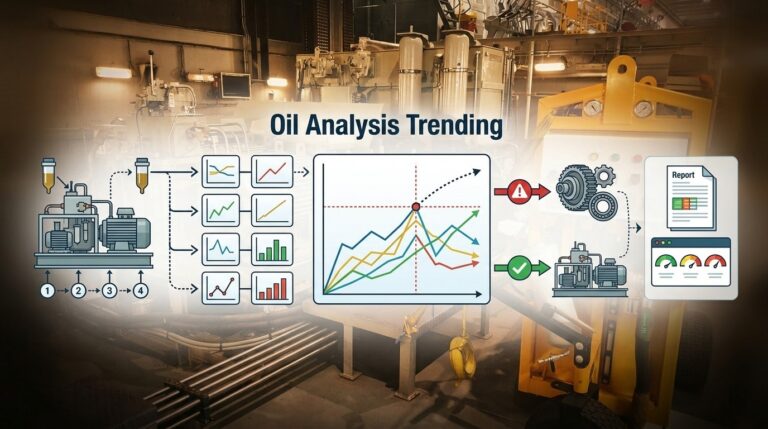
Accurate oil analysis interpretation relies heavily on trending results over time. Taking occasional oil samples does not provide enough information to establish reliable wear patterns or detect developing problems.
Regular oil sampling helps identify changes in wear metals, contamination levels and lubricant condition before failures become severe.
Sampling inconsistencies or contamination during collection can also affect results. For this reason, corrective action should never be based on a single sample alone. Suspect results should always be confirmed with additional testing.
Maintaining a regular sampling schedule is the key to accurate condition monitoring and early fault detection.
Clean Oil Services works closely with your maintenance team to help interpret results and recommend appropriate corrective action.
If abnormal equipment behaviour or operating issues are observed, it is important to advise us immediately. Even minor operational details can assist in accurately diagnosing potential problems from oil analysis results.
Oil analysis reports should also be reviewed alongside microscopic images and previous sample results to monitor changes in wear patterns, contamination and oil condition over time. If you do not fully understand your report, your laboratory should provide support and guidance to help you maximise the value of your oil analysis program.
Setting Oil Analysis Limits
When do we raise the alarm?
One of the most debated areas in condition monitoring is determining the correct alarm limits for wear metals, contamination levels and drain intervals. There is no universal set of limits that suits every operation.
Oil analysis limits vary depending on:
- Equipment age and condition
- Operating environment
- Machinery application
- OEM recommendations
- Lubricant type
- Maintenance practices
- Production demands
Limits and parameters should be designed so as to target an overall improvement in machine operating conditions.
Many equipment manufacturers specify maximum wear debris limits and oil drain intervals that must be followed to maintain warranty compliance.
At Clean Oil Services, oil analysis limits are developed in consultation with the operator to ensure they match the operating conditions, maintenance goals and machinery condition of the site.
Why Oil Analysis Limits Must be Customised
Oil analysis limits should always be tailored to the individual operation and machine type. Using limits from another site or operation can produce misleading results because operating conditions vary significantly between industries, environments and machinery applications.
In many operations, older equipment may require different alarm levels than newer machinery. Some fleets may require multiple sets of limits depending on equipment age, operating hours and condition. Oil drain intervals may also vary.
Because operating conditions differ between applications, fixed limits may not always be suitable. Clean Oil Services can advise you on the most effective limits for your specific operation, and it’s important not to make those limits overly restrictive—leave room for unforeseen variation.
We will notify you whenever a limit is approached or exceeded.
The goal of oil analysis testing is not simply to flag failures, but to progressively improve machine condition, reduce contamination and optimise lubricant performance over time.
Although lubrication technology has advanced significantly, many industries still rely on outdated lubrication practices that increase operating costs and reduce equipment reliability. Today, lubrication should be viewed as a critical reliability function rather than a routine maintenance task.
An effective lubrication management program focuses on:
- Reducing contamination
- Extending oil life
- Improving machine reliability
- Reducing wear rates
- Preventing premature failures
- Minimising lubricant waste
- Increasing production up-time
Proper lubrication practices often reduce overall maintenance workload while delivering significant cost savings and operational improvements.
The Importance of Lubrication Training
Lubrication personnel play a critical role in machine reliability and must be properly trained in all aspects of lubricant management, including:
- Oil storage
- Handling procedures
- Sampling techniques
- Contamination control
- Lubricant application
- Oil disposal practices
Modern equipment operates under increasingly demanding conditions, making precision lubrication management more important than ever. Selecting an oil analysis provider based solely on price can often lead to poor results, inaccurate reporting and missed opportunities to improve equipment reliability.
Clean Oil Services Pty Ltd uses a combination of testing methods to provide accurate and reliable monitoring of machine and lubricant condition. These methods include:
- Spectrographic analysis
- Microscopic analysis
- Wear metal monitoring
- Contamination analysis
- Oil condition monitoring
Microscopic Oil Analysis
Microscopic analysis helps identify wear particles larger than 5-7 microns, which cannot be detected accurately by the spectrometer. Using microscopic analysis allows technicians to:
- Assess oil cleanliness
- Identify active wear particles
- Monitor contamination levels
- Determine whether wear particles are newly generated
- Evaluate overall oil condition
This testing method fills the gap left by spectrographic analysis and improves early failure detection.
Electron Microscope Analysis
In specialised situations, electron microscope scanning can be used to identify the alloy composition of individual wear particles.
This advanced testing method helps locate the origin of wear particles based on their alloying elements and is typically reserved for complex failure investigations or specialised monitoring applications.
A well-structured oil analysis program helps businesses improve preventive maintenance planning, reduce operating costs, and improve equipment reliability.
Regular oil testing allows maintenance teams to make informed decisions, avoid catastrophic failures, and maximise machinery performance. Clean Oil Services Pty Ltd works closely with clients to develop tailored oil analysis programs that support long-term reliability and operational efficiency.

Free Oil Analysis Assessment
Talk to Clean Oil Services Pty Ltd for a free assessment and discover how a professional oil analysis program can improve your maintenance planning, reduce downtime, and lower operating costs. Our team is committed to helping businesses improve machinery reliability, optimise lubrication practices, and reduce maintenance expenses across a wide range of industries.
Start improving your equipment reliability and lubrication management with professional oil analysis testing from Clean Oil Services Pty Ltd.

